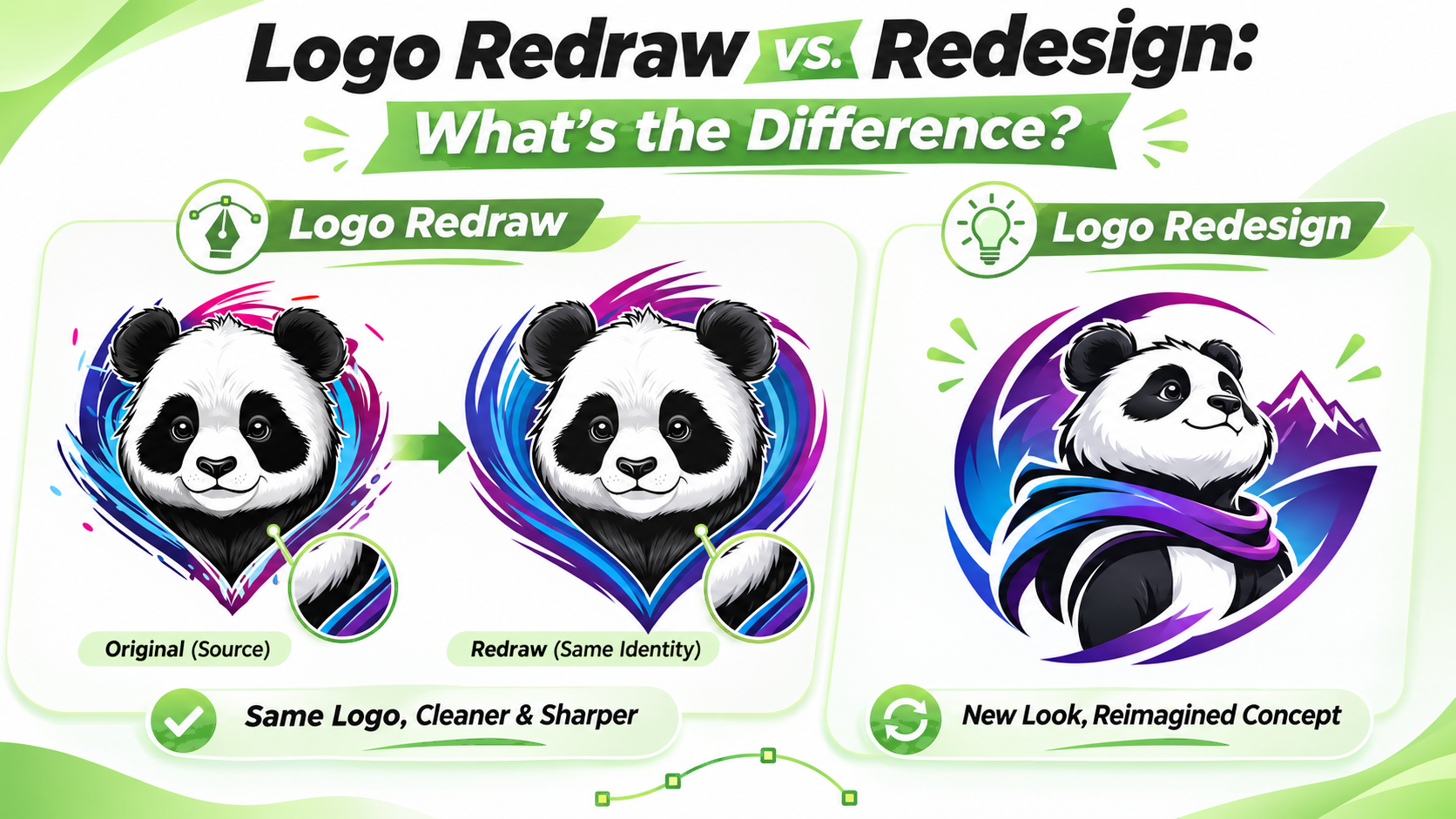
Your business logo looks blurry when printed on a large sign. The original design file is missing and all you have is a small JPG or PNG. Does that mean you need a completely new logo? Not necessarily. Many businesses confuse logo redrawing with logo redesigning. Although they sound similar, these services solve very different problems. Logo redrawing means recreating your existing logo while preserving its original design. Logo redesigning means changing the logo’s appearance, style, or visual identity. If you already like your logo but need a cleaner, scalable version, a professional logo redraw may be the right choice. If you want to change how your brand looks, a redesign may be more appropriate. Understanding the difference can help business owners, print shops, sign makers and apparel companies avoid unnecessary design changes.
What Is Logo Redrawing?
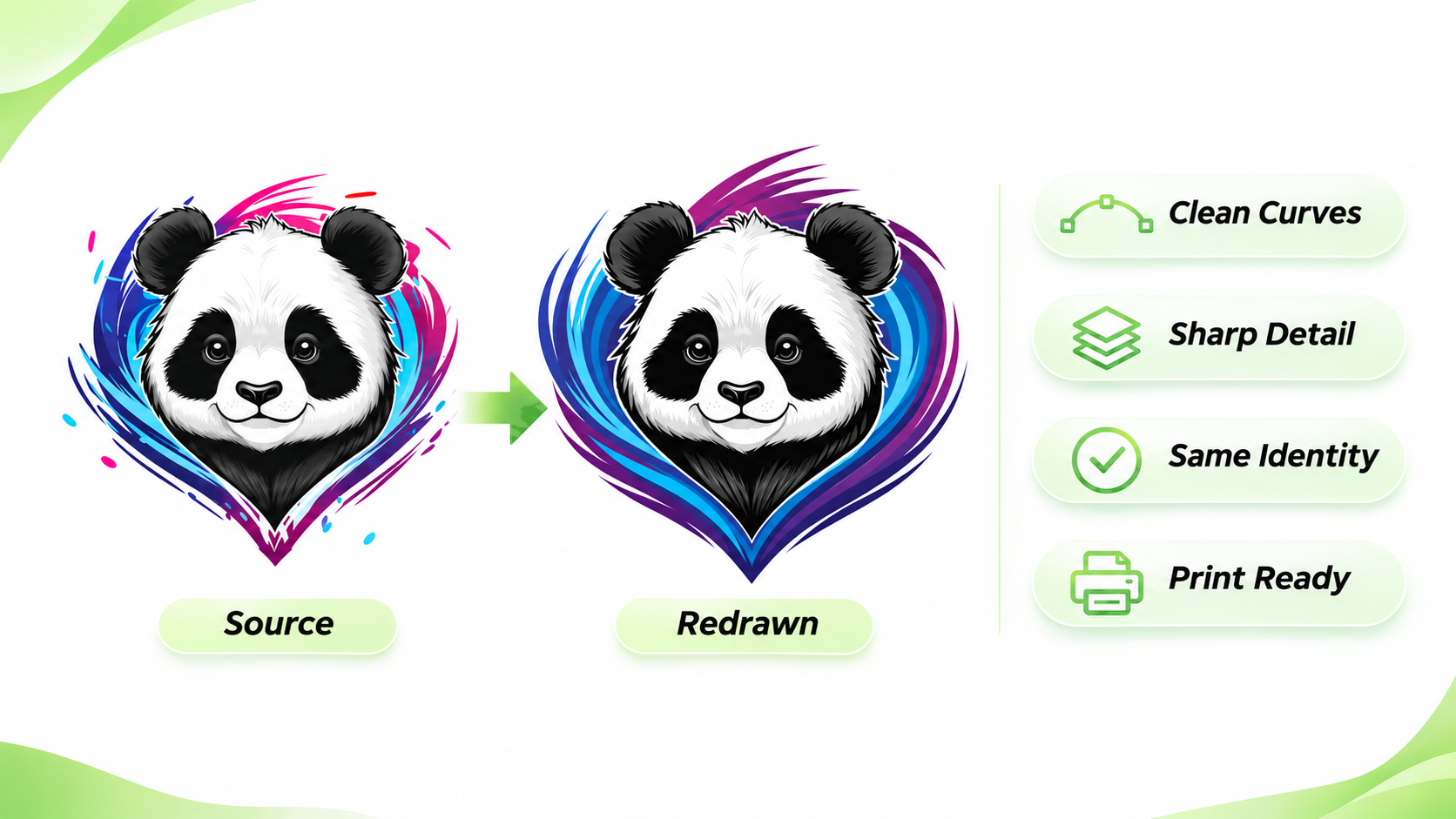
Logo redrawing is the process of recreating an existing logo to improve its artwork quality while keeping the original design as accurate as possible. A professional designer rebuilds the logo’s shapes, lettering, outlines and colors using vector drawing tools such as Adobe Illustrator. The goal is simple: Keep the original logo design, but create clean, editable, scalable artwork. For example, imagine a printing company receives a customer’s logo as a small, blurry PNG. The customer wants the same logo printed on T-shirts, business cards and storefront signage. Instead of designing a new logo, the artwork can be manually redrawn into vector format.
A professional logo redraw typically involves:
- Recreating the original logo shapes and outlines.
- Matching existing typography and lettering.
- Preserving the original colors and proportions.
- Correcting pixelated or jagged edges.
- Rebuilding clean, editable vector paths.
- Preparing suitable files for the intended applications.
At ManualVectorTracing.com, we specialize in manually recreating existing logos using Adobe Illustrator without relying on automatic tracing. Our logo redraw service focuses on preserving the original artwork while creating professional vector files.
What Is Logo Redesigning?
Logo redesigning is the process of changing an existing logo to create an updated or different visual appearance. Unlike logo redrawing, a redesign involves creative decisions about how the brand should look. A designer may change the typography, colors, symbol, layout or overall visual style. For example, a business might have used the same logo for 15 years but now wants a simpler, more modern identity. Instead of recreating the existing logo, the designer develops a revised design that reflects the business’s current direction.
Logo redesigning may include:
- Changing fonts or lettering styles.
- Introducing new brand colors.
- Simplifying complicated symbols.
- Updating the logo’s composition.
- Creating new graphic elements.
- Developing a different visual direction.
A redesign can be subtle or substantial, depending on the business’s goals. However, if your only problem is a blurry or low-quality logo file, redesigning the artwork may be unnecessary.
Logo Redraw vs. Logo Redesign: Key Differences
Both services can produce professional vector files, but they serve different purposes.
| Feature | Logo Redraw | Logo Redesign |
|---|---|---|
| Purpose | Recreate Existing Artwork | Update or change the logo |
| Original design | Preserved | Maybe modified |
| Typography | Existing lettering matched | Can be changed |
| Colors | Original colors maintained | New colors may be introduced |
| Creative changes | Generally avoided | Part of the process |
| Vector artwork | Common deliverable | Maybe included |
| Best suited for | Lost, blurry or low-quality logo files | Outdated or unsuitable visual identity |
A logo redraw solves an artwork-quality problem. A logo redesign addresses the design itself.
Can a Logo Be Redrawn Without Changing Its Original Design?
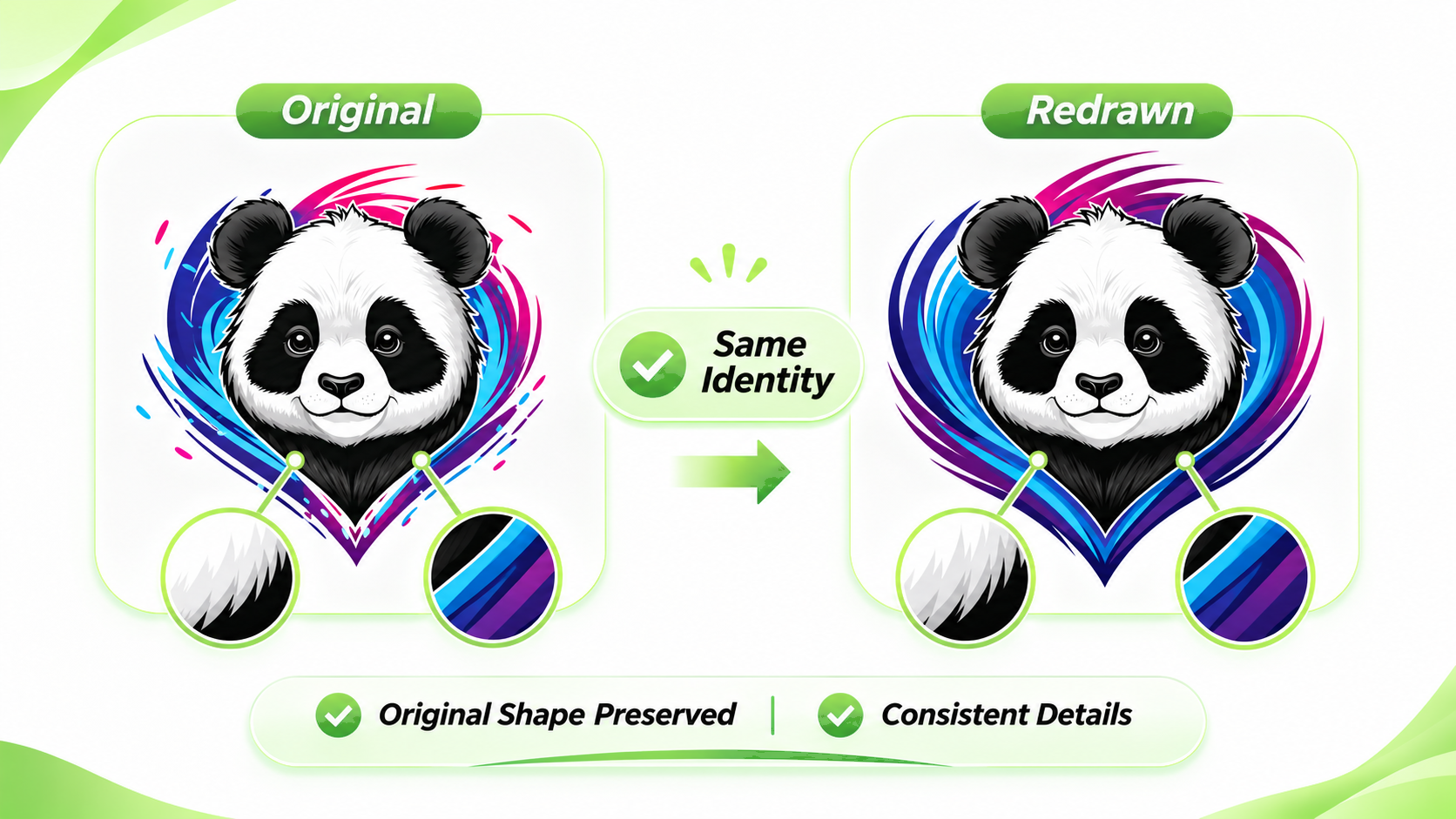
Yes. Preserving the original appearance is the primary goal of faithful logo redrawing. For businesses with an established identity, details such as letter shapes, curves, spacing and proportions are important. Even small differences can make a familiar logo look incorrect. During manual redrawing, the designer carefully reconstructs the artwork based on the supplied reference. This may include recreating customized lettering, adjusting vector curves and matching the original shape boundaries. However, no process can automatically recover visual information that is completely missing from a damaged or low-resolution image. If certain details cannot be identified, the designer should request better references or confirm the intended appearance with the logo owner. For a closer explanation of vector reconstruction, read our guide on What Is Vector Tracing?.
When Should You Choose a Logo Redraw?
Logo redrawing is usually the better option when your existing logo still represents your business and you want to keep it unchanged. Here are some common situations where logo redrawing makes sense.
1. Your Logo Is Blurry or Pixelated
One of the most common reasons businesses request logo redrawing is poor image quality. A logo saved as a small JPG or PNG may look acceptable on a website but become pixelated when enlarged. This happens because raster images contain pixels, and those pixels become more visible when the image is scaled beyond its available resolution. A manually recreated vector logo uses paths and shapes rather than relying on a fixed pixel grid. This allows the artwork to be resized without introducing the pixelation associated with enlarging the original raster image.
2. You Have Lost Your Original Logo Files
Many businesses lose access to their original design files over time. The logo may have been created years ago, and the designer may no longer be available. Sometimes the only remaining references are old business cards, website images, printed packaging, or photographs. A professional logo recreation service can use those materials to reconstruct the artwork. The accuracy of the result depends on the quality of the available reference. If lettering or details are unclear, additional references or approval may be necessary.
3. Your Print Shop Needs Vector Artwork
Print shops frequently receive logos in unsuitable formats. A customer might provide a low-resolution image when ordering a large banner, sign, or screen-printed T-shirt. The printing company may need clean vector artwork before preparing the job. Instead of changing the customer's established logo, manual redrawing can recreate the existing artwork in an editable format. The finished file should still be checked against the printer's specific requirements.
4. You Want to Preserve Your Brand Identity
An established logo may already appear on uniforms, vehicles, packaging, stationery, and signage. Changing its appearance could create inconsistencies between existing materials and new ones. A faithful redraw helps maintain the recognizable design while replacing low-quality artwork with a clean vector master.0
When Should You Choose a Logo Redesign?
A redesign may be appropriate when the visual appearance of the existing logo no longer meets your needs. For example, your business may have changed its services, target market, or brand positioning. You may also want a different design style.
Common reasons to consider logo redesigning include:
- Your business has changed direction.
- The current logo no longer reflects your brand.
- You want new typography or colors.
- The existing design contains unnecessary visual complexity.
- You are developing a new brand identity.
A redesign can address these concerns through creative changes. However, a logo that looks outdated because of blurry edges or poor file quality does not automatically need redesigning. It may simply need professional redrawing.
Why Manual Vector Redrawing Matters
Not all vector conversions produce the same results. Automatic tracing software can convert raster images into vector paths, but the results may include uneven curves, excessive anchor points, distorted lettering, or unwanted shapes. These issues can be especially noticeable in complex logos or low-resolution artwork. Manual vector redrawing gives the designer more control over the construction of each element. Instead of simply following detected pixel boundaries, the designer can recreate smooth curves, consistent outlines, and carefully positioned shapes.
This is particularly useful when working with:
- Detailed business logo.
- Custom lettering and typography.
- Illustrated emblems and mascots.
- Old or damaged artwork.
- Logos with complicated outlines.
- Artwork intended for large-format application.
Manual redrawing does not eliminate the need for careful quality checks, but it allows the designer to control the final vector structure directly. For professional production work, that control can be valuable.
Logo Redrawing for Printing, Signage and Apparel
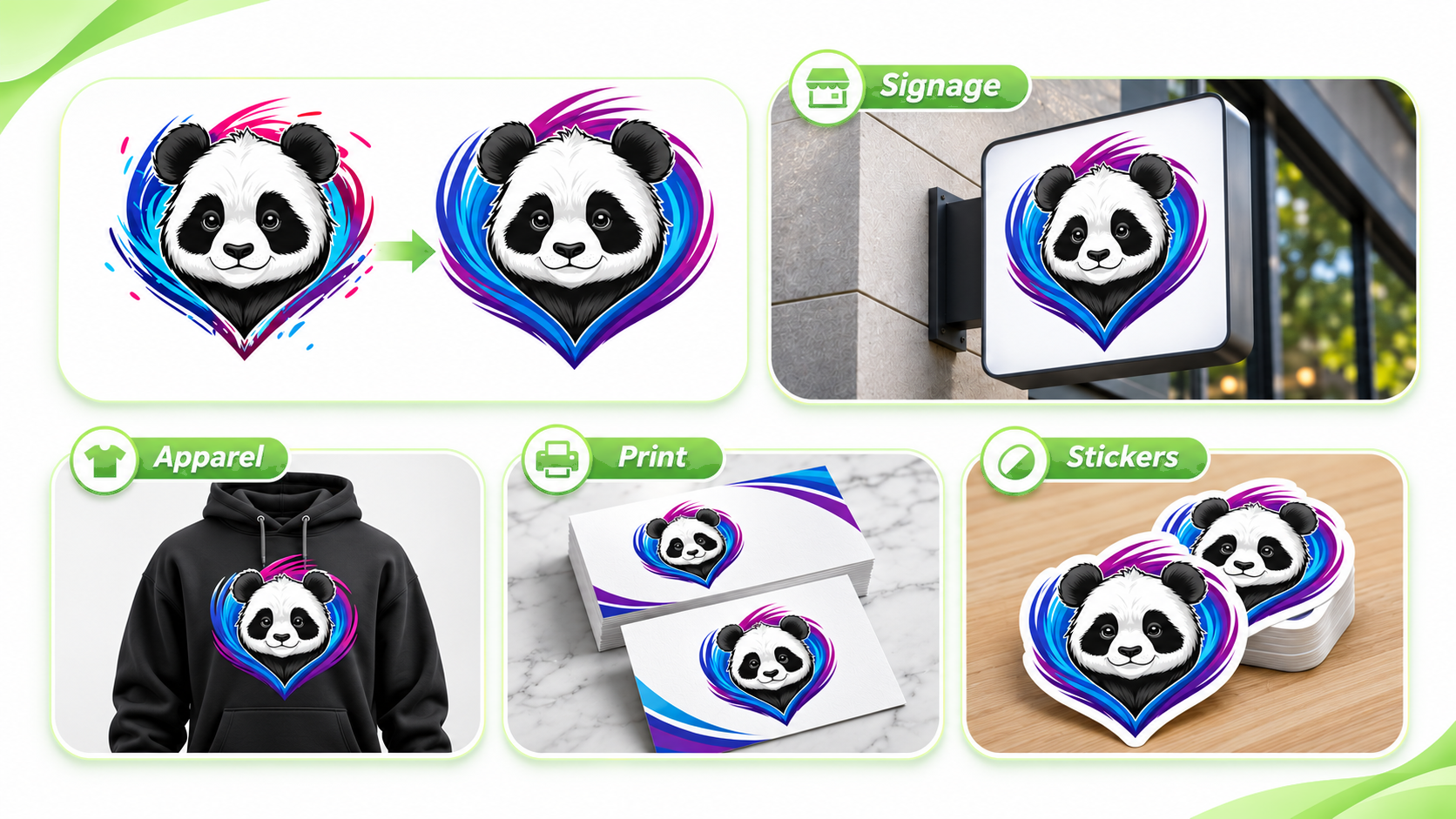
A clean logo file is important because businesses often use the same artwork across several applications.
Screen Printing
Screen printing businesses may receive customer logos as blurry images or screenshots. Manual redrawing can create clearly defined vector shapes that are easier to inspect and prepare for printing. Depending on the job, the artwork may also require color separation and other print-specific preparation.
Sign Making
Sign makers frequently need to enlarge customer logos for storefront signs, wall graphics, and outdoor advertising. Low-resolution images may not provide sufficient quality at large sizes. A properly reconstructed vector logo can maintain smooth outlines when scaled, while final production requirements depend on the sign-making process.
Embroidery
Embroidery providers often need clearly defined logo artwork before digitizing a design. A vector redraw can provide a useful reference for identifying lettering, shapes, and details. However, a vector file is not an embroidery machine file. Embroidery production generally requires a separate digitizing process.
Packaging and Labels
Packaging companies need consistent branding across products, labels, and printed materials. Using a clean vector master can make it easier to reproduce the approved logo at different sizes. Before production, the packaging supplier should confirm the required file format, colors, and printing specifications.
How Does Professional Logo Redrawing Work?
A professional logo redraw involves more than saving an image in a different file format. At ManualVectorTracing.com, the process focuses on reconstructing the original artwork manually in Adobe Illustrator.
Step 1: Review the Original Logo
The first step is to examine the supplied JPG, PNG, screenshot, scan, or other reference. The designer identifies the important shapes, lettering, colors, proportions, and details that must be preserved.
Step 2: Recreate the Artwork Manually
Using Adobe Illustrator, the designer rebuilds the logo with vector drawing tools. Individual shapes, curves, and outlines are constructed to match the original artwork as closely as possible.
Step 3: Refine the Details
The reconstructed logo is checked for uneven curves, misplaced elements, unwanted gaps, and differences from the reference. Lettering, spacing, colors, and proportions receive particular attention.
Step 4: Check the Vector Artwork
The completed vector artwork is inspected at different sizes. The designer checks whether the important details remain consistent and whether any unexpected shapes or gaps are present.
Step 5: Prepare the Final Files
Depending on the project requirements, vector artwork may be supplied in formats such as AI, EPS, SVG, or vector-based PDF. Each format has different applications. Importantly, simply saving an image as a PDF does not make it a true vector file. The artwork must contain vector elements rather than only an embedded raster image. The receiving printer or production partner should confirm which format is needed.
How to Decide Between Logo Redraw and Redesign
If you're unsure which service your business needs, start by identifying the real problem.
Choose logo redrawing when:
- You like your current logo.
- Your logo is blurry or pixelated.
- You lost the original vector file.
- Your printer needs editable artwork.
- You want to preserve the existing brand identity.
Choose logo redesigning when:
- You want a different appearance.
- Your existing logo no longer represents your business.
- You want to change colors, typography or symbols.
- You are planning a broader branding update.
- You need a new creative direction.
For example, if your sign company needs to reproduce a customer's existing logo accurately, a logo redraw is often the appropriate starting point. But if the customer wants new lettering, a different symbol, and updated colors, the project involves redesigning. The important thing is to agree on the intended outcome before work begins
Frequently Asked Questions
Is logo redrawing the same as logo recreation?
The terms are often used interchangeably. Both generally describe recreating an existing logo while preserving its original appearance. The exact scope should be agreed upon before the project begins.
Can a blurry logo be redrawn into vector format?
Yes. A blurry JPG or PNG can often be manually recreated as vector artwork. However, missing or unclear details may require additional references or confirmation.
Will my logo look different after redrawing?
A faithful logo redraw is intended to preserve the original design. The final artwork should closely match the supplied reference rather than introduce unrequested creative changes.
Is logo redrawing better than redesigning?
Neither service is universally better. Redrawing is appropriate when you want to keep the original logo. Redesigning is suitable when you intentionally want to change its appearance.
Can I use a redrawn logo for printing?
A properly constructed vector logo can be useful for printing, signage, packaging, and apparel decoration. The final artwork must still meet the requirements of the intended production process.
What files should I request after logo redrawing?
AI, EPS, SVG and vector-based PDF are common formats. The most suitable deliverables depend on your editing needs and the requirements of your printer or manufacturer.
Final Thoughts
Logo redrawing and logo redesigning are different services, and choosing the right one depends on what you want to achieve. If your existing logo still represents your business but the artwork is blurry, pixelated, or unavailable in vector format, professional logo redrawing may be the right solution. If your goal is to change the design itself, update the brand appearance, or introduce a new visual direction, logo redesigning may be more appropriate. Before making a decision, ask yourself one simple question:
Do I want to keep my existing logo, or do I want to change how it looks? The answer will help you choose the right service.
Need Your Existing Logo Redrawn?
At ManualVectorTracing.com, we specialize in manually recreating logos and artwork into clean, scalable vector files using Adobe Illustrator. Whether you have a blurry JPG, low-resolution PNG, old logo scan or missing vector master, you can send us your artwork for review. Tell us where you plan to use the finished logo and we'll help determine the appropriate vector artwork requirements.
Need a clean, print-ready vector file?
Get a Free Quote